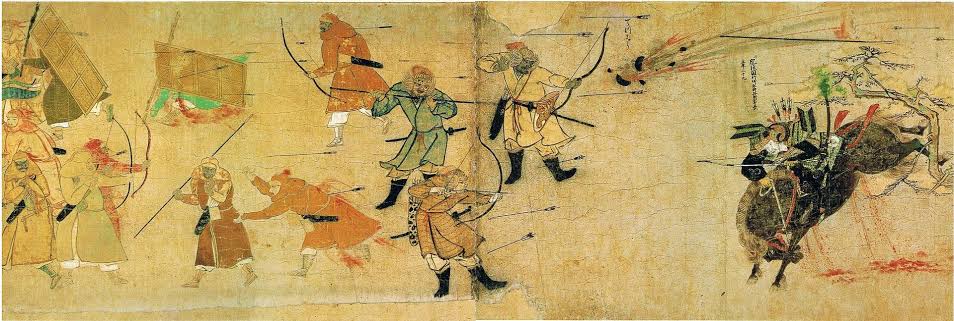
This week we focused on the Mongol invasion, looking at the scrolls of Takezaki Suenaga’s experiences fighting. The thing that I found really interesting is the idea that many of the records from that time are, in a way, written by unreliable narrators. There were rewards available for warriors that fought well. Therefore, it makes sense that in Suenaga’s story, he is portrayed as a fearless warrior. If he wanted to get as much of a reward as possible, he would not say that he was scared to go fight. Instead, it would make more sense for him to say that he was ready for battle, scared of nothing, which he did.
There was also the fact that in order to get the reward, one needed witnesses. The government did not believe that friends and family were trustworthy, so warriors would find strangers and agree to be witnesses for each other, which I think is really interesting. I wonder how much of the planning and strategizing of attacks revolved around the need for a witness. In Suenaga’s story, there was a point when he was told that he should wait for the witnesses before attacking, and I wonder if, had the need for witnesses not existed, or had there not been an opportunity to be rewarded, how much the battle itself would have changed.
I found this week’s discussions really easy to connect to the idea of who is telling the story, which I think is a really crucial thing to ask when reading primary sources. In general, primary sources provide a lens into how people were thinking about certain events during a time period, even if they do not necessarily provide detailed facts about the events themselves, and I think that this week’s readings were a perfect depiction of that idea. For example, the idea of the “divine wind” really stuck out in how it was written about differently between the Japanese and the Mongols. While the Japanese described the storm that occurred as more of a “cherry on top” of their win and God’s plan for them to be triumphant, the Mongols described it as a huge storm, using it as an excuse for their failure. I think this shows a really human aspect of the people fighting. I too would want to blame a storm that occurred if I failed at something, because it would be something else to blame.
Overall, I really enjoyed this week’s readings because it really provided insight into the mindset of historical figures.
Bibliography
Conlan, Thomas. In Little Need of Divine Intervention: Takezaki Suenaga’s Scrolls of the Mongol Invasions of Japan. Cornell East Asia Series, 113. Ithaca, N.Y.: East Asia Program, Cornell University, 2001.
“The Mongol Scrolls”. In Sources of Japanese Tradition, Vol. 1: From Earliest Times to 1600, compiled by Wm. Th. de Bary, Donald Keene, George Tanabe, and Paul Varley, 282-83. Second edition. Introduction to Asian Civilizations. New York: Columbia Univ. Press, 2001.
