This week we focused on Zen Buddhism and I found it really cool to learn actually what it was, since I feel like the word “zen” is used really generally by people who do not really, fully understand what the meaning is. We have already discussed other types of Buddhism, such as Pure Land Buddhism, and it was really interesting to learn about the differences. For one, zen Buddhism focuses on relying on one’s own power to reach enlightenment, while others focus on a sort of higher being. Also, in class we made a list of things that came to mind when we thought about the word “zen”, and many things were mentioned, such as spirituality, meditation, calm, balance, and peace, which are all aspects of enlightenment as it has been described. So, it was really cool to learn about a different type of Buddhism.
Another thing we focused on was different aesthetics in Japan during the Muromachi period. Zen Buddhism had a fairly large impact on art of the time. There were two ideals when it came to Japanese aesthetics that we discussed: wabi and sabi. Wabi means the idea of lack of pretentiousness and finding beauty in the imperfections of the art. For example, we looked at objects used during tea ceremonies that had a sort of rustic quality to them, where there were imperfections in the shape and the coloring that really embodied the idea of wabi. Sabi is the idea of depicting a sense of loneliness and melancholiness. So an example of sabi would be a piece of artwork that depicts a house surrounded by nature, being the only sign of human existence in that area. Similar to how “zen” has sort of been misused, the idea of wabi-sabi has also been used in a general sense without people really knowing the meaning behind each of the words individually. So, I am really happy that I was able to learn the specifics of what they actually mean.
In class, once we talked about wabi and sabi, we were able to walk around and look at different examples of art, including paintings, tea ceremony objects, and rock gardens, and had to figure out which idea pertained to each of them. I really enjoyed the assignment because I liked looking at the different types of art. I think my favorites were the objects for the tea ceremony, specifically the ones that embodied the ideal of wabi, because I have found that I am drawn to the imperfections in all types of art. So, it was really cool to see those imperfections and have them seen as a part of what makes them beautiful instead of the pieces being beautiful despite the imperfections.
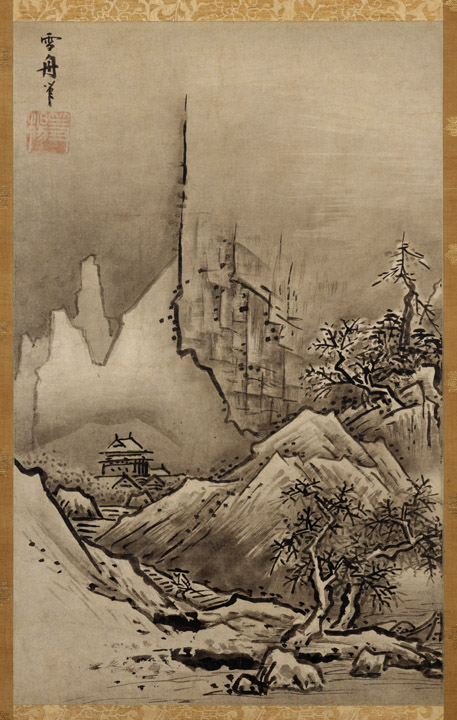
https://www.google.com/url?sa=i&url=https%3A%2F%2Fjapaneselandscape.wordpress.com%2Fliterati%2Fliterati-themes%2Ftheme-muromachi-ink-painting%2F&psig=AOvVaw1Lgp5zJRP3KW-xkbHz8C7K&ust=1681269769690000&source=images&cd=vfe&ved=0CBAQjRxqFwoTCLivjo3woP4CFQAAAAAdAAAAABAR
Bibliography
Ellwood, Robert, and Ellwood. “Zen Buddhism.” In Encyclopedia of Global Religions, by Wade Roof, and Mark Juergensmeyer. Sage Publications, 2011. https://muhlenberg.idm.oclc.org/login?url=https://search.credoreference.com/content/entry/sagegr/zen_buddhism/0?institutionId=4200
