EXPLORATION PACK: OPTION 1
Mythology has always been a really interesting aspect of history for me because I think it is really cool to look at how beliefs may have affected the actions of a society. The fact that the stories that people told each other as myths had such an impact on not only the culture of Japan but also how more logistical things like their hierarchy was structured is crazy to think about. Also, looking at the myths themselves and how they reflected society was interesting because it showed the way that myths and history have a sort of symbiotic relationship. One cannot learn about one without learning about the other. When we were looking at the tropes that appeared in mythology, since these myths were considered the official history, it is possible to use these to reflect the mindset of people during these historical times. I also really enjoyed looking at how this culture is still alive. Being Japanese, seeing the pictures of the matsuri brought back a lot of memories of holding the shrine and eating all of the food that was served. I had never known the full meanings behind everything, which also shines a light into how ingrained the results of the myths are into culture, since for me it was just tradition.
The other part of class that I found really interesting was the weaving of timelines and how affected Japan and Japanese culture was by its surroundings. When looking at what was happening in the Korean peninsula and on the Mainland at the same time as events in Japan, I could really see the cause and effect of history. A major example of this is the fact that with the Tang-Silla alliance, when they attacked Baekje, while it was not happening in Japan, the Japanese sent reinforcements and it had a major impact on Japan itself, since it led to the strengthening of Japan. This sort of cause and effect, where geographically, while they are close, they are still fairly separate, does not stop one event from impacting another.
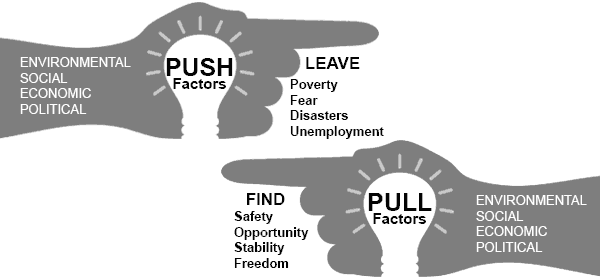
Lastly, the aspect of push/pull circumstances in understanding why so many people immigrated to Japan was interesting to look at because that is something that I think still applies today. No matter the place, there will always be push/pull factors. In Japan’s case, there were not that many pull factors, just because it was so new so people did not know what would pull them to immigrate to Japan, but the push factors, when generalizing them, could still apply today. Warfare was a significant one, and when thinking about refugees, that still applies today, as do circumstances such as famine and climate change. Because of this, I really enjoyed looking at that and thinking about it in terms of how different/similar it was to now.
Bibliography
https://sites.google.com/site/aphumangeographymigration/economic-push-and-pull-factors
Batten, Bruce. “9. Early Japan and the Continent.” In Japan Emerging: Premodern History to 1850, edited by Karl F. Friday. New York, NY: Routledge, 2018. https://muhlenberg.on.worldcat.org/oclc/787849954. pp. 89-95 [stop at “The fifth phase of …”]
Shirane, Haruo. Traditional Japanese Literature: An Anthology, Beginnings to 1600. Abridged ed. Translations from the Asian Classics. New York: Columbia University Press, 2012.
