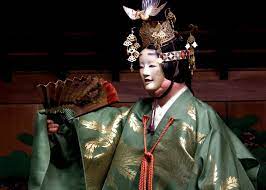
This week we focused on the Muromachi period, specifically on the arts, which I really enjoyed. I loved discussing Noh theater and the specifics of the art form. As a theater major, this should not be surprising. It was also really interesting to see how the values of storytelling in this period can still be connected to theater and acting today. For example, the metaphor of the marionette and the strings, where the marionette is the body and the performance, while the strings are the mind that controls everything, really resonated with me. Seeing the work that goes into the performance takes the magic away from the performance itself, and even if the work is really well done, I feel like the best performances are when the thinking aspect is invisible. I also really enjoyed reading about and talking about the idea of Yugen and the tranquil beauty that can come through in any character.
We then watched a video of a Noh performance of Atsumori, a story that we read before. To be completely honest, while reading about the artform was really interesting, I found myself not fully being able to connect with the performance itself. This might be just because I am so used to a more western style of theater, and intellectually I can see the skill that goes into performing it, but I found it difficult to really connect to the story in a way that was not just thinking about how good it was. I do think, though, that I might get more out of it if I followed along, which I knew was an option in class but I did not do.
I loved watching the video of the acting techniques, though. It was so cool to see the specificity in the movement qualities since it is such a vital part of the performance. Also, this does not really have to do with the historical aspect, but it was really cool to hear it being taught in Japanese, and how it was translated into English, because there were some things that were not exact but got the message across, which has always fascinated me about translations. I cannot think of any examples but I found myself laughing at some of the translations, before realizing that while the literal words had different meanings, the general meaning and vibe of what was being said stayed the same.
Bibliography
Seami Motokiyo. “The Art of Nō”. In Anthology of Japanese Literature: Earliest Era to Mid-nineteenth Century, compiled and edited by Donald Keene, 259-262. Unesco Collection of Representative Works. New York: Grove Press, 1955.
