This week, we focused on the Edo period. On Wednesday, we discussed “sekoku”, or the isolationism of Japan from the rest of the world. Of course, there were exceptions, but Japan mostly blocked itself off from foreign influence. In the source that we read, The Edict of 1635, there were very clear rules that kept Japan separate from the rest of the world, such as the prohibition of foreign travel, with execution being the punishment for those who tried. However, it is interesting that the Dutch were excluded from this. “Rangaku”, which literally translates to Dutch studies, made its way into the sciences, specifically medicine and astronomy. We looked at books that were used for translators, which was really interesting, again, given how against foreign relations Japan was, other than this.
Although, on Friday, I was not in class, I was able to read about Kabuki theater, which really interested me. I wrote about it in my Absence reflection, but it reminded me of a Japanese musical theater troupe called the Takarazuka Revue. While Kabuki is all men, Takarazuka is all women. So, the male parts are played by women, many of whom just have slightly deeper voices. I was also reminded of Shakespeare, which also only had male performers for a time. It really interested me because, at least in my experience, theater has been very much a female dominated artform, with many of my acting classes and dance classes being majority female, so it was interesting to learn that it was not always that way.
Something that really stood out to me when learning about Kabuki was a sort of parallel to Noh, the emotions did not come from facial expressions themselves. In Noh, as we discussed, the masks covered the performers’ faces, so all of the emotion was shown through physicality as well as the angle at which the mask was being shown. On the other hand, Kabuki really relied on makeup. There was one detail about how the red makeup being worn on the face symbolized a really strong emotion because it represented the blood vessels that pop when someone is having a really intense feeling, which was something that I did not know.
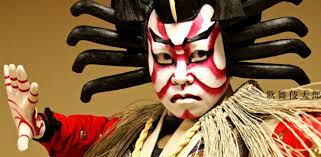
https://www.google.com/url?sa=i&url=https%3A%2F%2Fjapaneseonimasks.com%2Fblogs%2Fmagazine%2Fthe-buying-guide-for-kabuki-mask&psig=AOvVaw0FsH409IRBjkTLGKUEhiAX&ust=1682476906100000&source=images&cd=vfe&ved=0CBAQjRxqFwoTCND_-oSBxP4CFQAAAAAdAAAAABAI
Bibliography
“Closing the Country.” In David John Lu. Japan: A Documentary History, 220-228. Armonk, NY: M.E. Sharpe, 1997.
“Kabuki in Japan.” Japanology, NHK.
